
Why Transformation Is an Executive Decision System
By Stephen Allan
Founder, Elevate Transformation
Transformation is shaped by a relatively small number of consequential enterprise decisions. The quality of those decisions can determine everything that follows.
Major transformations generate enormous amounts of activity.
Strategies are developed.
Business cases are approved.
Programmes are mobilised.
Technology is selected.
Operating models are redesigned.
Roadmaps are built.
Governance forums meet.
Thousands of decisions are made along the way.
But not every decision has the same consequence.
Some decisions determine what the organisation is trying to become.
Where should we focus?
What outcomes matter most?
Where will value come from?
Which capabilities must change?
What should receive investment?
What are we prepared not to do?
These choices shape the transformation itself.
And once they are made, hundreds of other decisions begin flowing from them.
That is why enterprise transformation is more than a delivery system.
It is an executive decision system.
The challenge is not simply making decisions.
It is identifying the decisions that matter—and making them well.
Some Decisions Shape the Enterprise
Transformation requires decisions at every level.
Programme teams decide how work should be sequenced.
Project teams resolve delivery issues.
Specialists make technical choices.
Functions determine how changes will be implemented within their areas.
Those decisions matter.
But a smaller set of decisions sits above them.
These determine the direction of the enterprise itself.
They include choices about:
- why transformation is necessary
- which strategic priorities should guide it
- what outcomes define success
- where enterprise value can be created
- what capabilities the future organisation requires
- which opportunities deserve scarce resources
- what trade-offs leadership is prepared to make
These decisions cannot be treated like ordinary programme approvals.
They create the boundaries within which much of the transformation will operate.
A weak delivery decision may affect a workstream.
A weak enterprise decision can affect the entire transformation.
That distinction deserves greater attention.
Approval Is Not the Same as Decision Quality
Organisations are often very good at approving decisions.
Papers are prepared.
Recommendations are presented.
Governance forums discuss them.
Executives endorse a preferred option.
Minutes record the outcome.
The decision is made.
But the existence of an approval does not tell us whether the underlying decision was strong.
A consequential transformation decision can be approved while important assumptions remain untested.
Alternatives may have been considered too narrowly.
Trade-offs may remain implicit.
Evidence may support the preferred option without adequately challenging it.
The downstream consequences may not be fully understood.
Or leaders may agree on the decision without agreeing on what would cause them to reconsider it.
This matters because transformation decisions are rarely made with perfect information.
They involve uncertainty.
Competing priorities.
Dependencies.
Risk.
Organisational interests.
And incomplete evidence.
The objective cannot be certainty.
It must be decision quality under uncertainty.
Make the Decision Explicit
One of the simplest ways to improve decision quality is to become clearer about the decision being made.
Transformation discussions can easily move from problem to solution without defining the choice in between.
A technology platform is proposed.
A restructuring is recommended.
A programme is accelerated.
An investment is approved.
But what is the underlying enterprise decision?
A stronger conversation starts by making it explicit.
What decision are we actually making?
That question sounds simple.
It is not.
The decision may not be whether to implement a particular technology.
It may be whether a capability should be built internally or sourced externally.
It may not be whether to restructure a function.
It may be whether accountability should move closer to the customer.
It may not be whether to approve another initiative.
It may be where the organisation should concentrate scarce transformation capacity.
Defining the decision clearly improves everything that follows.
Better Decisions Require Better Questions
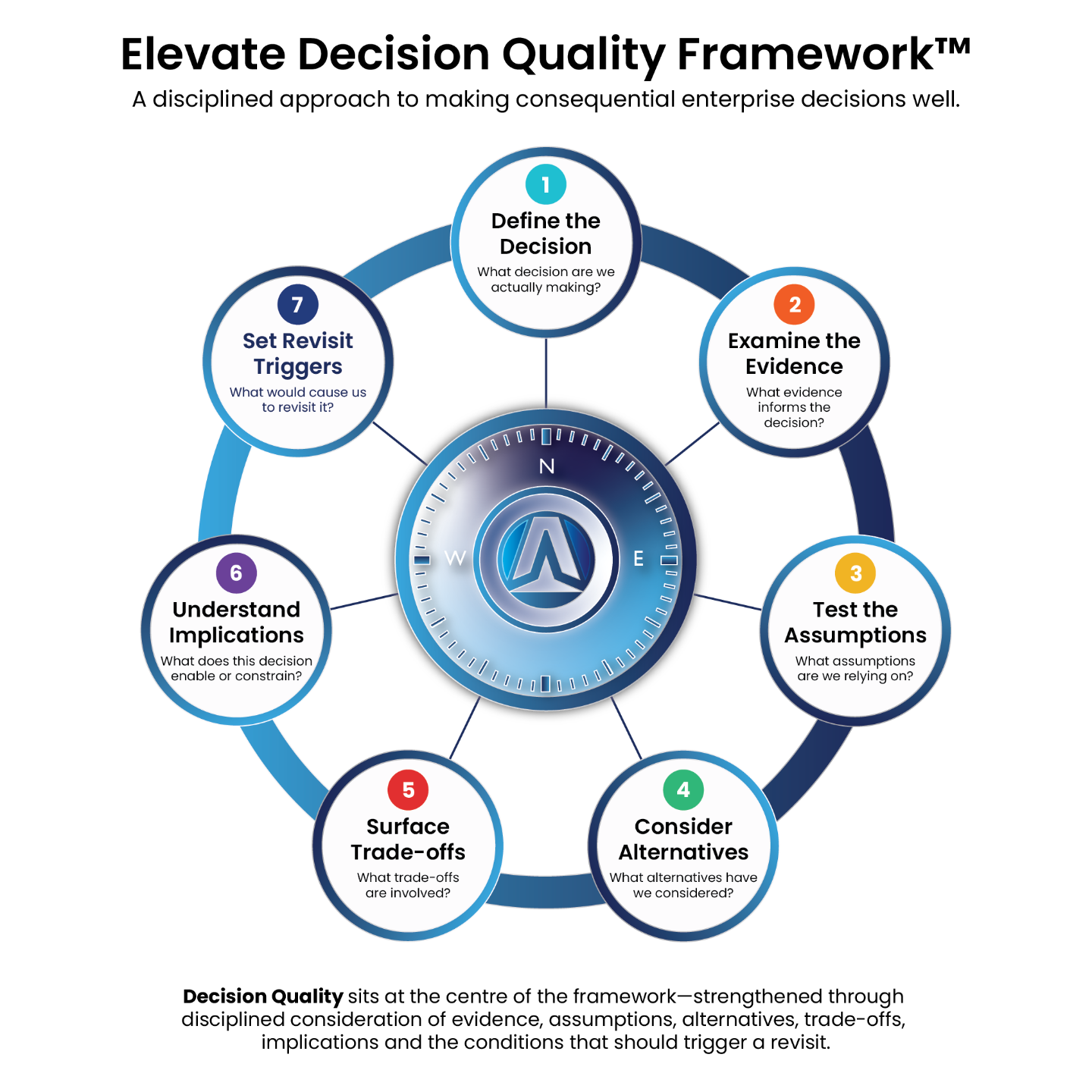
The Elevate Decision Quality Framework™ provides a consistent discipline for testing consequential transformation choices.
The framework moves leaders beyond:
What should we do?
towards a more complete set of questions.
What decision are we actually making?
Is the decision clearly framed, or are we debating solutions before agreeing on the underlying choice?
What evidence informs the decision?
What do we know, what do we believe, and what evidence supports or challenges the recommendation?
What assumptions are we relying on?
Which assumptions materially affect the decision, and which would change the conclusion if they proved wrong?
What alternatives have we considered?
Have credible alternatives genuinely been tested, including the option not to proceed?
What trade-offs are involved?
What are we gaining, what are we giving up and where will the consequences be felt?
What does this decision enable or constrain?
How will this choice affect capabilities, investment, sequencing, other initiatives or the future enterprise?
What would cause us to revisit it?
Which conditions or new evidence would justify reopening the decision?
These questions do not remove uncertainty.
They make the uncertainty more visible.
And that enables better judgement.
Evidence Should Inform Judgement—Not Replace It
Transformation increasingly provides leaders with more information.
Market data.
Customer insight.
Operational analytics.
Scenario modelling.
Risk analysis.
Financial forecasts.
And increasingly, AI-supported analysis.
This should improve decision-making.
But more information does not automatically create better decisions.
Evidence still needs interpretation.
Different data can support competing choices.
Forecasts rely on assumptions.
Historical evidence may be less useful when the environment is changing.
And some of the most consequential transformation choices involve questions for which there is no objectively correct answer.
How much disruption is the organisation prepared to absorb?
How much short-term performance should be traded for future capability?
Where should enterprise standardisation outweigh local flexibility?
How much risk is acceptable to move faster?
Analysis can illuminate these choices.
It cannot make them.
Enterprise transformation therefore requires both evidence and judgement.
The discipline lies in knowing how they work together.
Trade-Offs Should Be Visible
Weak transformation decisions often hide their trade-offs.
A recommendation is presented primarily through its benefits.
The costs are quantified.
Risks are recorded.
But the broader enterprise choice can remain less visible.
Every significant transformation decision closes some possibilities while opening others.
Investing in one capability means less capacity somewhere else.
Accelerating one priority may increase organisational pressure.
Standardisation may create efficiency while reducing local flexibility.
Automation may create productivity while changing workforce requirements.
A future-state decision may create enterprise value while challenging established functional interests.
None of these automatically makes the decision wrong.
But they should be explicit.
A strong decision does not pretend there is no trade-off.
It demonstrates that leadership has understood the trade-off and chosen deliberately.
Understand the Wider Implications
Consequential transformation decisions rarely sit in isolation.
A strategic choice can change which capabilities matter.
A capability choice can change operating-model requirements.
An operating-model choice can alter technology, workforce and process needs.
Those choices affect investment.
Investment affects sequencing.
Sequencing creates dependencies.
The consequences continue through execution.
That means a decision should not be judged only by whether it solves the immediate issue.
Leaders should also ask:
What does this choice make possible?
and:
What does it make harder?
This is particularly important for decisions made early in transformation.
Their effects can propagate across the enterprise long after the original decision has disappeared from executive attention.
Decision quality therefore depends partly on understanding the system surrounding the decision, not simply the decision in isolation.
Good Decisions Can Still Need to Change
A well-made transformation decision is not a permanent commitment to the original answer.
Conditions change.
Assumptions prove wrong.
New evidence appears.
Customer responses differ from expectations.
Technology evolves.
Value cases strengthen or weaken.
The discipline is not to defend every previous decision.
It is to understand why the decision was made and what would justify revisiting it.
This is why the question:
What would cause us to reconsider this decision?
matters.
It creates a bridge between commitment and adaptability.
Leaders can move forward with confidence without pretending the future is certain.
And when circumstances change, they can distinguish between unnecessary churn and legitimate reasons to change course.
A strong decision system therefore does not make transformation rigid.
It makes adaptation more disciplined.
The Enterprise Transformation Framework and the Decision Quality Framework Solve Different Problems
This creates an important distinction within the Elevate system.
The Enterprise Transformation Framework provides the decision pathway.
It helps leaders understand the critical questions that need to be resolved as transformation moves from strategic framing through design, delivery and realisation.
The Decision Quality Framework™ strengthens the quality of consequential decisions made along that pathway.
One provides the pathway for what must be resolved across transformation.
The other strengthens how consequential decisions along that pathway are made.
The two are complementary.
Because knowing which decision comes next does not guarantee it will be made well.
And excellent decision technique does not help if the organisation is solving the wrong transformation question.
Transformation needs both decision architecture and decision quality.
Better Transformation Starts With Better Decisions
Enterprise transformation will always require strong delivery.
Programmes matter.
Projects matter.
Technology matters.
Change leadership matters.
Governance matters.
But before much of that activity can create value, leaders will have made decisions that determine what all of it is trying to achieve.
Those decisions deserve a discipline equal to their consequence.
Not more bureaucracy.
Not endless analysis.
Not consensus for its own sake.
A clearer way to frame the choice.
Better evidence.
Visible assumptions.
Credible alternatives.
Explicit trade-offs.
An understanding of wider enterprise implications.
And clarity about when new information should cause the decision to change.
Because transformation is ultimately shaped by the choices organisations make about their future.
And the more consequential the transformation becomes, the more important the quality of those choices becomes.
Enterprise transformation is an executive decision system.
And better transformation starts with better decisions.
Explore the Elevate Perspective
The Elevate Enterprise Transformation Framework provides a repeatable decision pathway from strategic intent through transformation design, execution and sustained value.
The Elevate Decision Quality Framework™ strengthens the quality of the critical enterprise decisions made along that pathway.
Explore the Elevate Enterprise Transformation Framework →
Take the free Leadership Alignment Diagnostic →
Explore Elevate Advisory →